
Key Takeaways
- Hidden inefficiencies in your MRO supply chain can quietly drain 10–20% of spend.
- Maverick spend and poor storeroom management are two of the biggest drivers of indirect procurement costs.
- Excess and obsolete inventory create significant inventory leakage and tie up working capital.
- Lack of spend visibility prevents effective MRO cost reduction strategies.
- Emergency purchases are often symptoms of planning and governance gaps.
- Sustainable MRO supply chain optimization requires an integrated, data-driven approach—not transactional cost cutting.
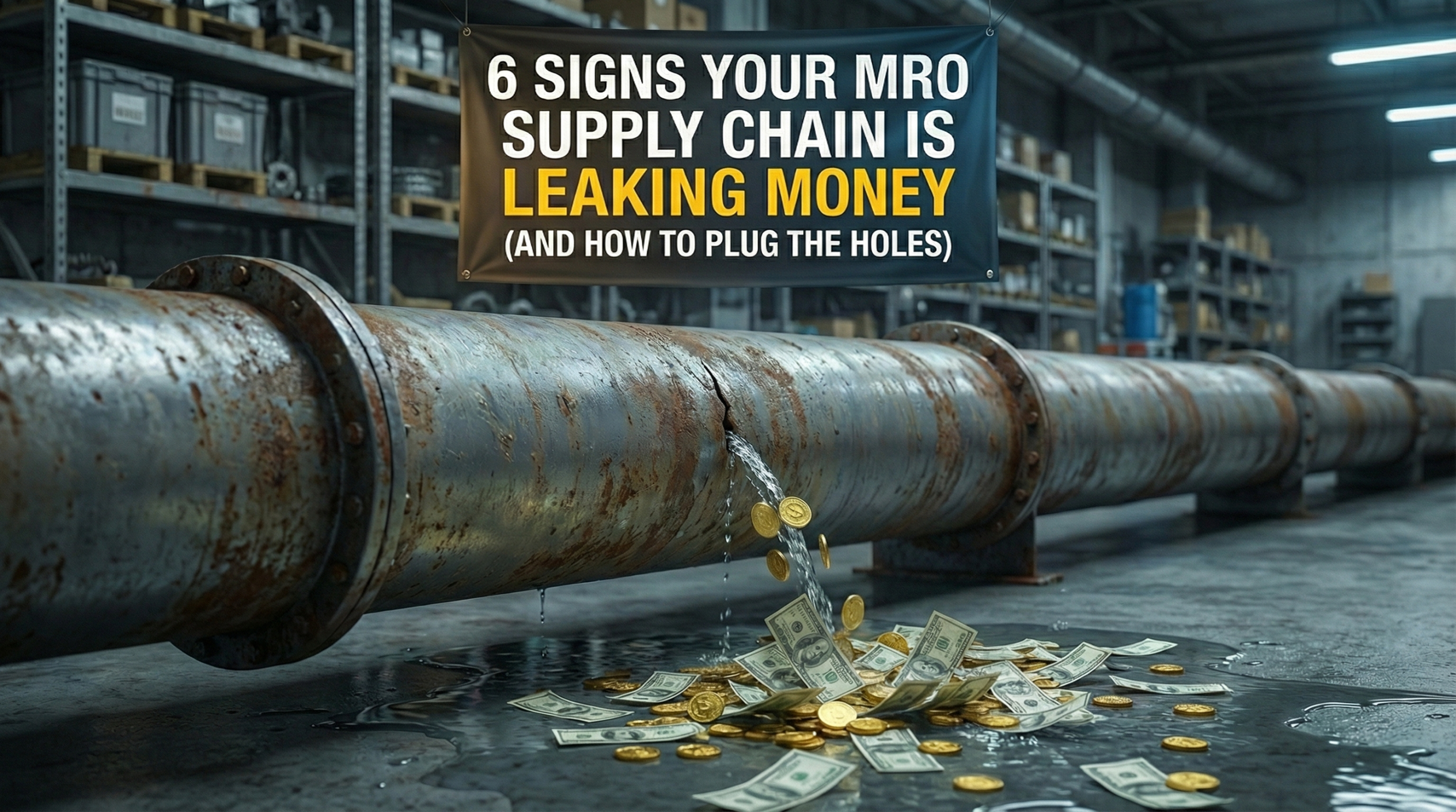
For most industrial organizations, the MRO supply chain doesn’t show up on the P&L as a headline cost. But when inefficiencies accumulate—fragmented buying, excess inventory, inconsistent data visibility—it quietly drains millions from operating margins.
Unlike direct materials, MRO often lacks governance and strategic oversight. The result? Hidden waste that erodes uptime, inflates working capital, and limits operational agility.
If you’re serious about MRO supply chain optimization, start by asking: Where is our supply chain leaking money?
Below are six of the most common warning signs—plus immediate actions you can take to plug the holes and accelerate long-term MRO cost reduction.
1. Maverick Spend Is the Norm, Not the Exception
When technicians or plant teams bypass approved suppliers to make one-off purchases, costs escalate quickly.
The Leak:
- Uncontrolled maverick spend
- Missed contract pricing
- Duplicate vendors
- Increased indirect procurement costs
- Compliance and quality risks
Without centralized controls, purchasing becomes reactive instead of strategic.
Immediate Fix:
- Enforce approved supplier lists
- Implement catalog-enabled buying
- Integrate procurement into ERP workflows
- Monitor spend by user, category, and site
Long-Term Solution:
SDI’s integrated supply model consolidates suppliers, standardizes procurement processes, and leverages advanced analytics through Zeus to eliminate off-contract purchasing—without slowing maintenance operations.
2. You’re Carrying Excess and Obsolete Inventory
MRO inventory often accumulates “just in case.” Over time, that safety cushion becomes expensive dead stock.
The Leak:
- Working capital tied up in slow-moving parts
- Overstocked SKUs with minimal usage
- Obsolete items tied to retired equipment
- Write-offs and storage inefficiencies
This is classic inventory leakage—and it frequently hides in plain sight.
Immediate Fix:
- Conduct ABC and criticality analysis
- Identify non-moving inventory (12–24 months no usage)
- Rationalize SKUs across facilities
- Standardize parts enterprise-wide
Long-Term Solution:
Through advanced analytics and optimized storeroom management, SDI helps reduce on-hand inventory while maintaining service levels—freeing capital without increasing downtime risk.
3. Your Storeroom Is Disorganized and Unmanaged
An unmanaged storeroom is one of the largest hidden drivers of waste in MRO environments.
The Leak:
- Duplicate parts in multiple locations
- Inaccurate cycle counts
- Emergency purchases due to stock discrepancies
- Lost technician productivity searching for materials
Poor storeroom management increases indirect procurement costs and reduces operational efficiency.
Immediate Fix:
- Standardize bin locations and labeling
- Improve cycle counting cadence
- Audit physical vs. system inventory
- Assign clear governance ownership
Long-Term Solution:
SDI transforms storerooms into digitally enabled supply hubs—integrated with ERP systems, automated replenishment triggers, and real-time usage visibility.
4. You Lack Real-Time Spend and Usage Visibility
If you can’t see it, you can’t optimize it.
The Leak:
- Fragmented systems and siloed data
- Limited reporting on usage trends
- Inaccurate demand forecasting
- Poor understanding of total indirect procurement costs
Without data transparency, decisions are reactive and inconsistent.
Immediate Fix:
- Centralize ERP and CMMS data
- Standardize KPIs (inventory turns, fill rates, spend per asset)
- Track total cost of ownership—not just price
Long-Term Solution:
Zeus provides advanced dashboards, predictive analytics, and spend intelligence—empowering procurement leaders to proactively drive MRO supply chain optimization.
5. Emergency Purchases Are Increasing
Frequent expedited orders signal systemic planning gaps.
The Leak:
- Rush shipping fees
- Spot-buy pricing
- Production downtime
- Strained vendor relationships
Emergency buys often stem from poor inventory strategy—not just unpredictable failures.
Immediate Fix:
- Align maintenance planning with inventory strategy
- Identify and appropriately stock critical spares
- Analyze root causes of stockouts
Long-Term Solution:
By aligning procurement, planning, and predictive insights, SDI reduces emergency purchases while protecting uptime and service levels.
6. Your MRO Strategy Is Transactional, Not Strategic
If MRO is treated as a purchasing task rather than a supply chain strategy, savings remain untapped.
The Leak:
- Limited supplier governance
- No enterprise-wide standardization
- Reactive cost-cutting efforts
- Inconsistent performance tracking
Immediate Fix:
- Establish cross-functional MRO governance
- Set enterprise optimization targets
- Benchmark performance across sites
Long-Term Solution:
SDI delivers an end-to-end integrated supply solution—combining sourcing, digital transformation, analytics, and operational execution. Unlike traditional distributors, we embed within operations to drive sustainable MRO cost reduction—not just price savings.
FAQs
What is MRO supply chain optimization?
MRO supply chain optimization is the strategic process of improving how maintenance, repair, and operations materials are sourced, stored, managed, and replenished. It focuses on reducing indirect procurement costs, eliminating maverick spend, minimizing inventory leakage, and improving uptime through better data visibility and governance.
What causes inventory leakage in MRO environments?
Inventory leakage typically results from excess safety stock, obsolete inventory, inaccurate system records, poor storeroom management, and lack of SKU standardization. Without strong analytics and governance, inventory accumulates and working capital is unnecessarily tied up.
How can companies reduce maverick spend in MRO?
Organizations can reduce maverick spend by:
- Implementing approved supplier programs
- Enabling catalog-based purchasing
- Integrating procurement systems with ERP workflows
- Monitoring real-time spend analytics
An integrated supply partner can also centralize vendor management and enforce compliance without slowing operations.
Why are indirect procurement costs so high in MRO?
Indirect procurement costs increase due to fragmented suppliers, emergency purchases, inefficient storerooms, manual processes, and lack of spend visibility. Because MRO often lacks strategic oversight, these costs accumulate unnoticed.
The Real Cost of Ignoring MRO Leakage
Individually, these leaks may seem manageable. Collectively, they can represent:
- 5–15% excess inventory carrying costs
- 10–20% uncontrolled maverick spend
- Millions in avoidable indirect procurement costs
- Lost productivity and downtime risk
The good news? Most organizations already have the data needed to fix these issues—they simply need the right strategy and execution partner.
From Cost Center to Competitive Advantage
True MRO supply chain optimization goes beyond cutting costs. It delivers:
- Reduced working capital
- Improved asset uptime
- Enterprise-wide standardization
- Greater procurement transparency
- Data-driven decision-making
At SDI, we help industrial leaders plug the leaks—and build digitally enabled, resilient MRO ecosystems powered by analytics, governance, and operational expertise.
Ready to Identify Your MRO Leaks?
If your MRO supply chain is quietly draining resources, now is the time for a comprehensive assessment.
Contact SDI today to schedule an MRO optimization diagnostic and uncover immediate savings opportunities.