

Key Takeaways
- Fear Drives Hoarding: Facility managers often hold onto obsolete parts out of a fear of downtime, tying up massive amounts of capital.
- Hoarding Doesn’t Equal Readiness: A full storeroom often hides the fact that you are missing the actual parts that keep your critical assets running.
- Carrying Costs are Quietly Draining Your Budget: Keeping obsolete inventory on the shelves costs you roughly 25% of that inventory’s value every single year in taxes, insurance, and space.
- A Structured Audit is the Cure: Separating critical spares from obsolete stock through a risk-based framework reduces downtime and frees up working capital.
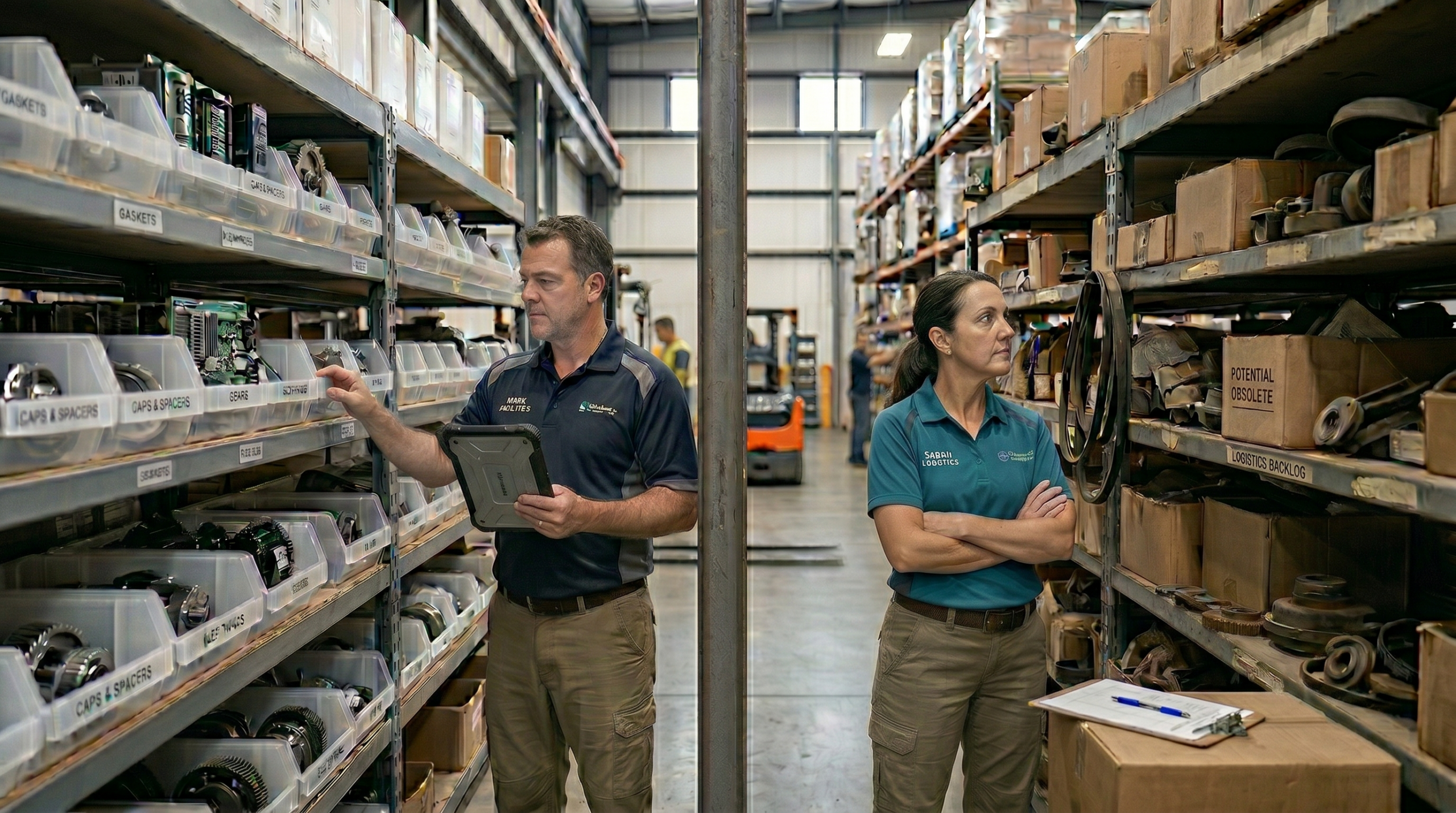
Walk into almost any manufacturing or facility storeroom, and you will see shelves packed to the ceiling. It looks like readiness. It feels like security.
But if your most critical production line goes down at 2:00 AM, can you find the exact part you need to get it back up? Or are you staring at thousands of parts for machines you decommissioned five years ago?
At SDI, we’ve walked hundreds of storerooms and analyzed millions of MRO (Maintenance, Repair, and Operations) SKUs. We understand the psychological trap of MRO inventory. The logic is simple and empathetic: “If I throw this away, the machine will break tomorrow, and it’ll be my fault.”
But holding onto “just-in-case” inventory isn’t a strategy; it’s a liability.
Today, we are going to look at the exact framework we use to help supply chain leaders execute an uncompromising “Critical Spares” audit, separate the trash from the treasure, and build a storeroom that actually protects your operation.
The Hidden Cost of the “Just In Case” Mindset
Before we fix the storeroom, we have to talk about the cost of doing nothing.
Many procurement leaders view paid-for inventory as a sunk cost. It’s already on the shelf, so it’s free to keep it there, right? Wrong.
Industry benchmarks show that the annual cost of holding inventory is roughly 25% of the inventory’s total value. This includes:
- Warehouse space and utilities
- Insurance and taxes
- Labor to count and move it
- Depreciation and degradation (parts rust, rubber dry-rots)
If you are holding $1,000,000 in obsolete stock, you are bleeding $250,000 a year just to look at it. Reducing inventory carrying costs starts with identifying what is actually protecting your business and what is just taking up space.
Critical Spares vs. Obsolete Stock: Knowing the Difference
To clean out the storeroom, you need radical honesty. You must categorize every item by its actual utility, not its perceived value.
What is a Critical Spare? A critical spare is a part that, if missing, will result in immediate production downtime, severe safety risks, or catastrophic environmental compliance failures. These are parts with long lead times or high difficulty to source. This is your treasure.
What is Obsolete Stock? Obsolete stock consists of parts that belong to equipment you no longer own, parts that have degraded beyond usability, or parts that are so easily sourced (e.g., standard fasteners available locally in 10 minutes) that storing them in bulk is unnecessary. This is your trash.
Effective critical spares management ensures you have 100% availability of the former, and 0% of the latter.
A 3-Step Framework for Your Critical Spares Audit
At SDI, we help our clients simplify the chaos of their supply chain. Here is the 3-step plan to execute an audit that actually drives results.
Step 1: Conduct a Critical Equipment Analysis
You cannot know what parts are critical until you know what machines are critical. Rank your equipment based on its impact on production.
- Tier 1: If this machine stops, the whole plant stops.
- Tier 2: If this machine stops, production slows down or workarounds are required.
- Tier 3: If this machine stops, it’s an inconvenience but production continues.
Your critical spares are the specific, hard-to-source parts that keep Tier 1 (and sometimes Tier 2) machines running.
Step 2: Execute Obsolete Inventory Identification
Pull your inventory data and walk the floor. Look for the “dust indicator”—if a box has a thick layer of dust, investigate it. Cross-reference your current inventory against your active asset list. If you have belts for a conveyor system that was ripped out in 2019, flag them.
Step 3: Implement Risk-Based Inventory Planning
Now that you know what matters, define your MRO stocking strategy.
- Keep: Retain your true critical spares. Optimize their minimum/maximum levels based on supplier lead times.
- Return/Sell: Can you return unopened, obsolete parts to the supplier? Can you sell them to a liquidator?
- Scrap: Throw the rest away. Yes, it hurts. But reclaiming the shelf space and stopping the carrying cost bleed is the only way forward.
FAQs
How much does carrying obsolete MRO inventory actually cost my business?
Industry standards dictate that holding inventory costs roughly 25% of the inventory’s value annually. This accounts for warehousing, utilities, insurance, taxes, shrinkage, and depreciation. Holding $500,000 in obsolete parts is costing you roughly $125,000 a year.
How is a Critical Spares Audit different from a regular inventory count?
A regular inventory cycle count only tells you what you have and how many. A Critical Spares Audit tells you why you have it, whether you should have it, and ties the physical part directly to the risk profile of your production equipment.
Should I manage my MRO inventory in-house or outsource it?
If your core competency is manufacturing, food processing, or retail, managing MRO parts is a distraction from your primary business. Outsourcing MRO management to an expert like SDI gives you access to specialized inventory algorithms, $1B+ in collective buying power, and dedicated storeroom personnel, allowing your team to focus strictly on production and maintenance.
How long does an SDI storeroom audit take?
The timeline depends on the size of your facility and the state of your current MRO data. However, our preliminary assessments and data-cleansing phases can often identify massive savings opportunities within the first 30 to 60 days.
The Cost of Inaction vs. The Value of Clarity
The failure of the status quo is a storeroom that actively fights against you. It is a facility where technicians spend 45 minutes searching for a vital bearing, only to find three bins of useless, rusted widgets. It is an operation where millions of dollars in capital are trapped in dust-covered boxes, creating a false sense of security while your actual critical spares run dangerously low.
The success of a formalized audit is immediate. By separating the trash from the treasure, you achieve a 15-30% reduction in carrying costs. You maximize your asset uptime because your technicians can actually find the parts they need, exactly when they need them. You transform your storeroom from a disorganized liability into a lean, resilient engine for your supply chain.
You don’t have to tackle this alone. SDI leverages $1B+ in collective buying power and specialized inventory algorithms to help you separate the signal from the noise. We have the engineering expertise, the data-cleansing technology, and the manpower to execute a ruthless, highly effective audit.
Ready to stop hoarding and start optimizing? Schedule an MRO Storeroom Audit with SDI Today.