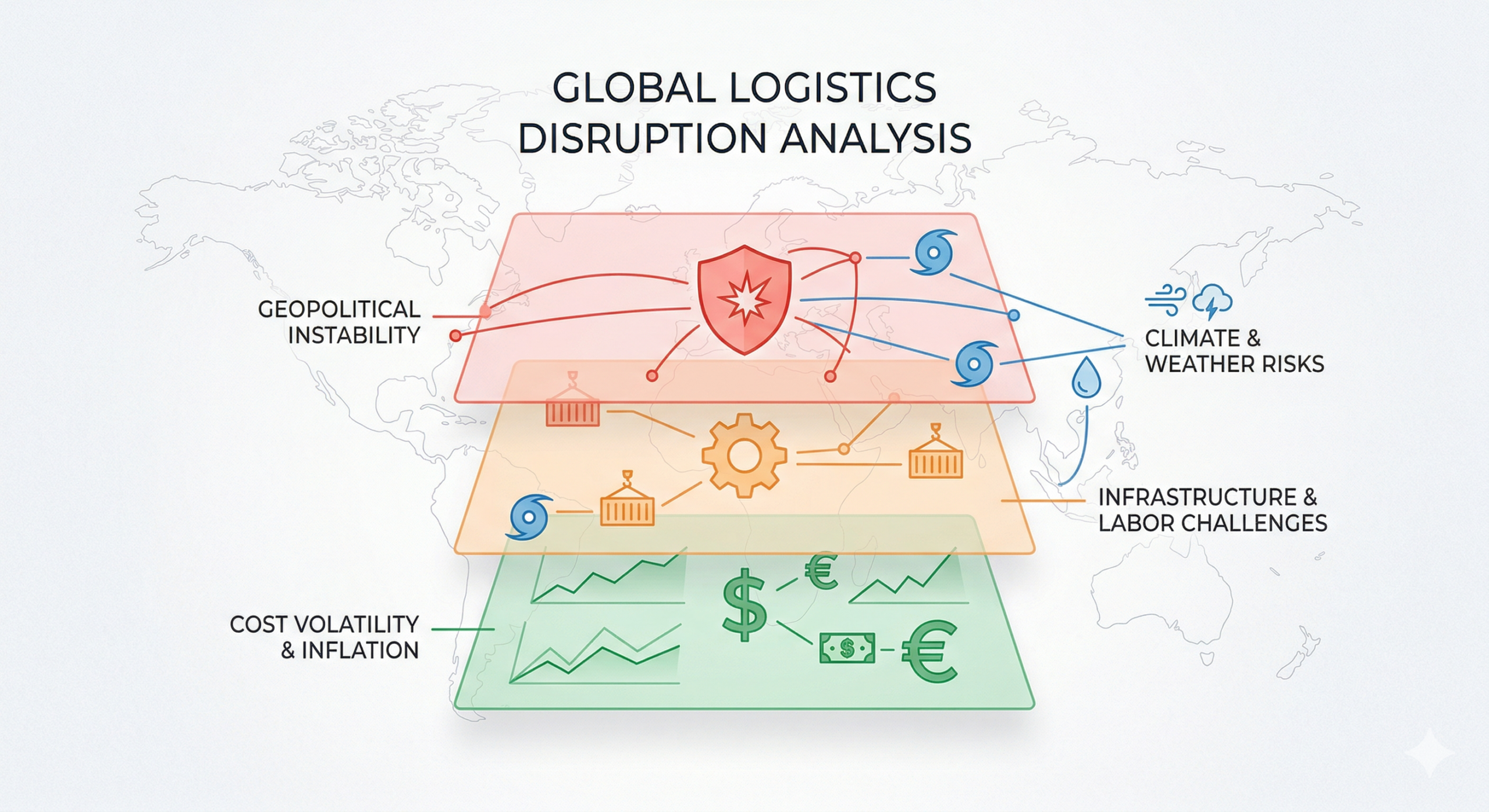

Structural Volatility Is Now Embedded in MRO and Supply Chain Operations
If December 2025 established that elevated tariffs are a permanent operating condition, January confirmed a more precise and consequential reality: the volatility is no longer arriving from the outside. It is now operating from within.
There were no sweeping policy announcements to open the year. No dramatic resets. What January delivered instead was a clear view of what sustained tariff exposure looks like at the operational level — and for asset-intensive organizations, the signals are worth close attention.
The January Pattern: Volatility Migrates from Price to Process
The dominant theme of January was not cost inflation. It was process friction — quiet, cumulative, and compounding.
Four specific dynamics defined the month:
1. Documentation Scrutiny is Intensifying
Manufacturers and distributors are reporting more aggressive verification requirements tied to country-of-origin certifications, alloy composition, domestic content attestations, and reclassification reviews on fabricated assemblies. The effect is visible across fasteners, electrical housings, tooling assemblies, and metal-enclosed safety components. Purchase orders that once moved without friction are now triggering verification cycles. When documentation gaps surface, parts stall — and in MRO environments, delay translates directly to downtime exposure.
2. Distributor Behavior is Shifting Under Margin Pressure
As elevated tariff baselines persist, regional distributors are quietly narrowing SKU profiles on thin-margin categories, reducing inventory depth on high-volatility items, and prioritizing higher-volume accounts. The result: approved suppliers may remain on paper, but their inventory strategies have changed. For decentralized MRO operations, this surfaces as longer backorder cycles, forced substitutions, increased spot buys, and more frequent expedited freight — not sourcing errors, but ecosystem adjustments.
3. Fasteners Remain a Foundational Pressure Point
If 2025 was defined by broad metals exposure, January reinforced that fasteners carry disproportionate structural risk in 2026. Tariff premiums in the 15–25% range continue to apply depending on alloy composition, origin, and classification interpretation. More significantly, availability is fragmenting: plants sourcing identical SKUs across regions are reporting divergent lead times and price stability. Fasteners may appear tactical in a budget line. Operationally, they are foundational. When they stall, production stalls.
4. Budget Assumptions Built on 2025 Pricing are Already Under Stress
January financial reviews are revealing early variance in MRO categories tied to fabricated metal components, electrical enclosures, safety hardware, and tooling. The challenge is not dramatic price spikes — it is unpredictability. Quote validity windows continue to compress. Lead times fluctuate week to week. Supplier exposure varies by region. In 2026, the core budgeting problem is not price level. It is volatility modeling.
What This Means for Executive Decision-Makers
Taken together, January’s signals confirm that the tariff environment is not stabilizing — it is operationalizing. Enforcement mechanisms are embedding into daily procurement workflows. Documentation requirements are adding latency to purchasing cycles. Supplier rationalization is reshaping availability. Regional variability is widening.
None of these developments are dramatic in isolation. Collectively, they are cumulative — and MRO absorbs cumulative friction before it surfaces anywhere else in the organization.
The organizations demonstrating resilience in January are not those that have optimized for cost benchmarking. They are those that have moved to operating model redesign: pre-validating tariff classifications at the SKU level, expanding regional supplier optionality, modeling fasteners and fabricated components as distinct risk categories, adjusting inventory buffers to reflect volatility exposure, and integrating maintenance planning with procurement timing.
This is no longer a procurement function adjustment. It is a leadership-level operating decision.
What to Monitor in February and Beyond
Several dynamics are likely to intensify in the coming months:
- Broader derivative classification scrutiny from customs authorities
- Increased domestic content documentation requirements
- Further supplier SKU rationalization in thin-margin categories
- Continued compression of quote validity periods
- Widening regional availability imbalances
Across scenarios, one conclusion holds: structural volatility persists, and its effects will compound for organizations that have not yet embedded resilience into their MRO operating models.
From Awareness to Structural Advantage
January did not bring shock. It brought confirmation — and with it, a clearer strategic question for leadership teams:
The issue is no longer how to respond to tariffs. It is how to build an MRO ecosystem that absorbs volatility without operational damage.
Organizations that outperform in 2026 will not be those waiting for policy relief. They will be those that have treated MRO resilience as a core operational capability — governed, measured, and continuously adapted to a structurally volatile trade environment.
SDI helps manufacturers and asset-intensive organizations modernize their MRO operating models for exactly this environment. Through our ZEUS-powered ecosystem — connecting procurement, supplier networks, analytics, compliance, and maintenance planning — we help organizations reduce tariff exposure, expand supplier optionality, protect uptime, and restore cost predictability.
If January has surfaced pressure points in your MRO strategy, the time to act is before volatility compounds further.