
Key Takeaways
- Visibility is Your Best Defense: You cannot optimize what you cannot see. Fragmented supplier networks and siloed purchasing lead to bloated inventory and critical asset downtime.
- AI Requires Clean Data: A digital control tower isn’t magic. Implementing advanced analytics or AI on top of “dirty” MRO data and rogue spend will only automate your inefficiencies.
- Sole-Sourcing is a Liability: Relying on a single Original Equipment Manufacturer (OEM) guarantees future stockouts. Resilience requires identifying functional equivalents and alternative suppliers before a crisis hits.
- The Status Quo is Expensive: Waiting for the supply chain to “normalize” costs organizations millions. Elite procurement teams are abandoning reactive purchasing for prescriptive, data-driven control towers.
The global supply chain hasn’t returned to “normal,” and waiting for it to do so is a failing strategy. Today, procurement leaders and facility managers are battling a permanent state of volatility: geopolitical shifts, labor shortages, erratic inflation, and sudden climate disruptions.
When you manage Maintenance, Repair, and Operations (MRO), these external pressures compound an already massive internal problem: a severe lack of visibility.
Most organizations struggle to understand the true total cost of their facilities maintenance and parts supply chain. “Dirty” data, decentralized purchasing, and functional silos create a perfect storm of excessive expedited shipping costs, trapped working capital, and—most tragically—critical asset downtime.
We understand how frustrating it is to be held responsible for performance goals when you are working with blind spots. To gain control, mitigate risk, and drastically reduce costs, elite supply chain teams are abandoning reactive purchasing in favor of a Digital Supply Chain Control Tower.
Here is exactly what that means, the brutal reality of what happens if you get it wrong, and the five steps you must take to build one today.
What is a Digital Supply Chain Control Tower?
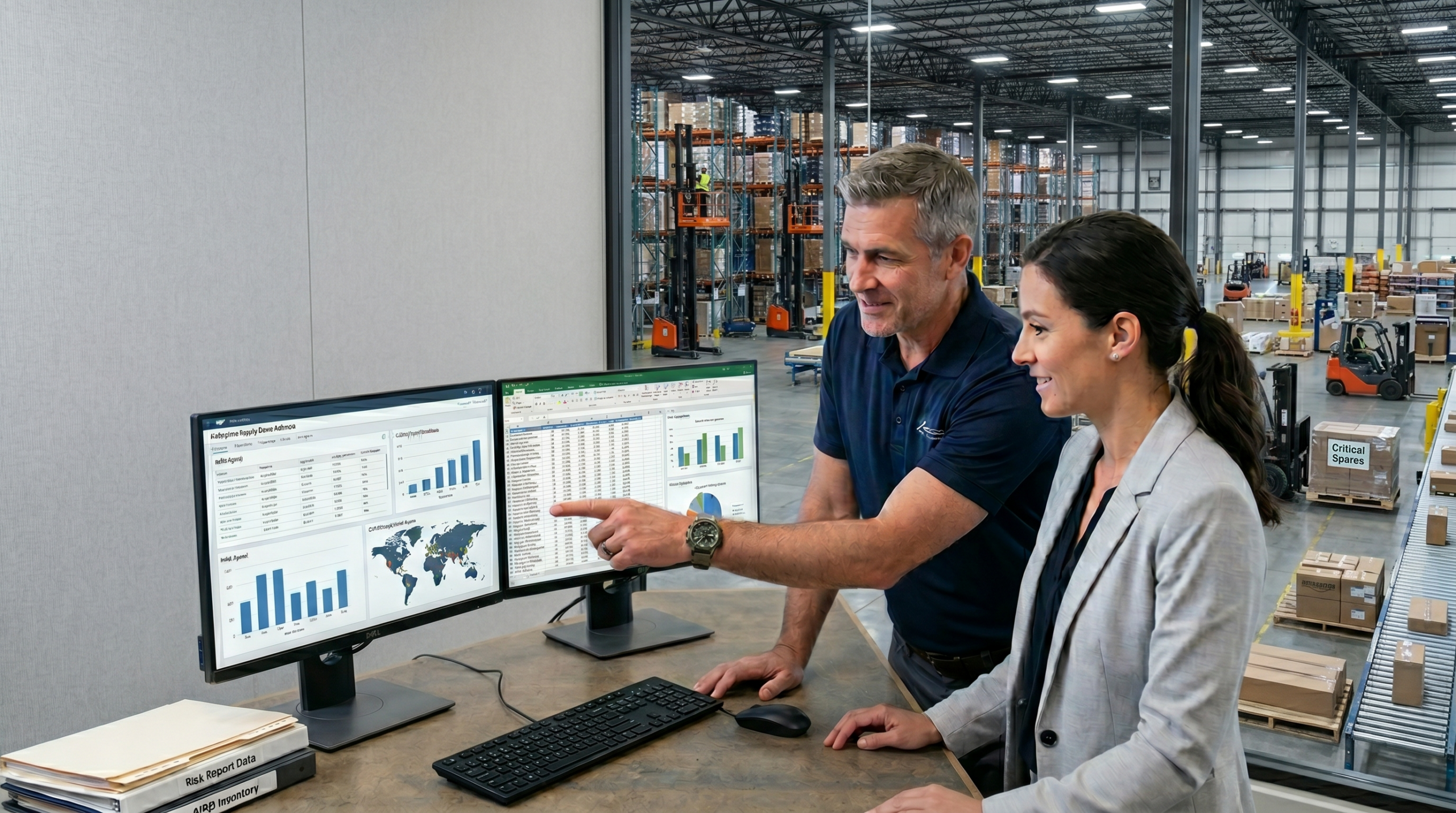
A digital supply chain control tower isn’t a physical room with wall-to-wall monitors. It is a centralized, connected data ecosystem that integrates your entire MRO supply chain—from enterprise asset management (EAM) and procurement to floor-level maintenance and supplier inventory.
By leveraging Advanced Data Analytics, Robotic Process Automation (RPA), and AI/Machine Learning algorithms (like SDI’s ZEUS platform), a control tower breaks down functional silos and eliminates manual processes.
The result? Real-time visibility that allows you to:
- Predict and mitigate bottlenecks before a critical machine goes down.
- Optimize inventory levels to free up working capital.
- Consolidate tail spend to drive down unit costs.
Let’s be radically transparent: Implementing a digital control tower will fail if you feed it garbage data. AI cannot optimize an MRO network built on misspelled part numbers, duplicate SKUs, and unmonitored P-card spend.
To achieve the proactive state of a control tower, you must first do the heavy lifting. Here is the 5-step roadmap.
5 Steps to Manage MRO Supply Chain Risk
1. Assign a Single Point of Accountability
The biggest internal threat to MRO efficiency is the “bystander effect.” Operations, procurement, and maintenance teams all touch the supply chain, but because they work in vacuums, no single person owns the holistic outcome. Operations and maintenance teams cannot be expected to meet performance goals when they lack alignment with procurement.
The Fix: Assign a dedicated accountability partner. Whether internal or a specialized third-party partner like SDI, someone must have the authority to lead the charge, ensuring that the technicians turning the wrenches are aligned with the leaders managing the budget.
2. Cleanse Your Data & Audit Your Parts Spend
This is the hardest part, but it is non-negotiable. Your accountability partner must review your parts spend data, starting with your top ten suppliers. You need to pull 2 to 3 years of purchasing data—invoices, P-card statements, and third-party contractor markups. You need to know exactly what you are buying, from whom, and how often.
What could go wrong here? Suppliers will often drag their feet. Many do not want to hand over detailed line-item data because it exposes inconsistencies in pricing. If you are a smaller organization, you may lack the leverage to demand this data.
- The SDI Advantage: SDI manages over $1B in collective buying power. When we ask thousands of suppliers for data, they answer. We scrub, categorize, and standardize your “dirty” data so your control tower has a pristine foundation to operate on.
3. Map Critical Assets for Predictive Forecasting
Not all spare parts are created equal. A stockout on breakroom supplies is an annoyance; a stockout on a specialized PLC for your main production line is a catastrophic revenue loss.
Interview your facility managers and technicians. Cross-reference the parts they deem “hardest to find” with your historical spend data. By identifying the parts tied to your revenue-generating assets, health and safety, and HVAC systems, you can build a predictive usage forecast. You stop buying parts “just in case” and start stocking them precisely when and where they will be needed.
4. Secure Alternative Sources & Functional Equivalents
In an age of constant disruption, relying on a single OEM is a massive risk. To build true supply chain resilience, you must identify secondary and tertiary suppliers, as well as exact functional equivalents for your critical spares.
The Reality of Cost: Finding alternative suppliers takes hundreds of man-hours, which drives up internal labor costs. However, the cost of a halted production line due to a missing $50 sensor is exponentially higher.
- Best in Class Tip: Forward-thinking organizations are now mitigating OEM stockouts by utilizing 3D scanning and print-on-demand services (additive manufacturing) to reverse-engineer obsolete or out-of-stock parts.
5. Shift from a Reactive to a Predictive Culture
A digital control tower is not a “set it and forget it” tool. It requires a culture committed to continuous improvement. Stop fighting fires and start asking the hard questions: Why are we doing it this way? Why are technicians waiting 45 minutes at the tool crib? How can we simplify?
As your control tower aggregates more data, you will graduate from a reactive domain to preventive, from preventive to predictive, and ultimately, to prescriptive operations.
FAQs
How much does it cost to implement a Digital Supply Chain Control Tower?
Building a control tower internally is highly capital-intensive. It requires purchasing enterprise software licenses, hiring specialized data scientists, and enduring months of internal IT integration, which can easily cost hundreds of thousands of dollars upfront. The Alternative: When you partner with an outsourced MRO expert like SDI, access to our proprietary ZEUS platform is built into the partnership. Because we typically generate 15-30% in direct cost savings through spend consolidation and inventory reduction, the implementation essentially pays for itself.
What are the biggest problems with building a control tower in-house?
The two biggest points of failure are dirty data and change management. Most internal ERPs are filled with free-text descriptions, duplicate items, and outdated pricing. If you plug analytics software into bad data, you get bad insights. Furthermore, internal teams often face heavy resistance from floor-level technicians who are used to buying from their preferred local vendors. SDI mitigates this by handling the master data cleansing upfront and placing dedicated personnel on-site to guide the cultural shift.
In-house Procurement vs. Outsourced MRO Management: Which is better?
If your core competency is manufacturing, retail, or food and beverage, managing millions of MRO parts is a distraction. In-house teams simply do not have the time to negotiate with 500 different tail-spend suppliers. Outsourcing to an expert gives you immediate access to pre-negotiated supplier catalogs, advanced inventory algorithms, and dedicated supply chain engineers—allowing your team to focus strictly on revenue-generating production.
How long does it take to see ROI from an MRO Control Tower?
While full digital maturity takes time, organizations typically see immediate ROI within the first 60 to 90 days of an engagement. This comes from immediate data cleansing, identifying obsolete inventory for liquidation, and routing rogue spend through preferred, discounted supplier contracts.
The Cost of Inaction vs. The Value of Clarity
The failure of the status quo is an operation that actively fights against you. It is a facility where you overpay for parts, where millions of dollars in capital are trapped in obsolete inventory, and where technicians are forced into costly workarounds because they lack the right materials. Working in a vacuum leaves your organization completely exposed to the next inevitable supply chain shock.
The success of a digital control tower approach is total operational clarity. You achieve a 15-30% reduction in total cost of ownership. You maximize your asset uptime because your teams can resolve critical issues in real-time. You transform your supply chain from a reactive liability into a resilient, optimized engine.
You don’t have to tackle this alone. SDI leverages decades of engineering expertise and digital solutions to connect the dots between your supply chain, facility management, and reliability strategies.
Here is our simple 3-Step Plan to get you started:
- Schedule an Assessment: We analyze your current MRO data, supplier base, and hidden risk factors.
- Implement the Tower: We deploy our ZEUS platform to cleanse your data and integrate your supply chain.
- Achieve Resilience: You lower costs, maximize wrench time, and gain total operational visibility.
Stop letting dirty data and reactive purchasing dictate your profitability.