
Key Takeaways
- The hidden bottleneck: Highly skilled technicians lose 20% to 30% of their shift walking to desktop terminals to look up and order parts, draining valuable wrench time.
- The honest truth: Legacy ERPs (like SAP and Oracle) are built for corporate finance and direct production planning—not for point-of-use speed on the plant floor.
- The comparison: Relying solely on an ERP for MRO creates administrative friction and maverick spend, whereas mobile procurement technology puts the storeroom directly in the technician’s pocket.
- The faster path to uptime: You do not need to rip and replace your ERP. Connecting a mobile-first eProcurement platform to your existing system is the fastest way to reduce technician downtime and protect asset reliability.
Walk the floor of almost any manufacturing plant, food processing facility, or distribution center, and you will see an expensive hidden cost eating into your maintenance budget: windshield time.
A critical line goes down. Instead of staying at the machine to complete the repair, a highly paid maintenance technician has to walk across a 400,000-square-foot facility to a desktop terminal, log into a complex enterprise system, and click through a dozen screens just to requisition a $12 proximity sensor.
If you are a facility manager, reliability leader, or procurement director, you already know why this happens. Your organization invested millions in a world-class ERP to manage enterprise resources—yet on the shop floor, why your ERP isn’t enough for MRO inventory management becomes painfully obvious every time an asset breaks down.
When evaluating ERP vs procurement software, the deciding factor comes down to one operational metric: Which tool keeps technicians at the wrench?
The Reality on the Shop Floor: Legacy ERP Limitations
Major ERPs are unmatched when it comes to general ledger accounting, financial compliance, and predictable direct-material bills of materials (BOMs). However, reactive Maintenance, Repair, and Operations (MRO) operates under entirely different rules.
When maintenance teams are forced to rely strictly on desktop ERP modules, three legacy ERP limitations immediately slow down repairs:
- Desktop and Terminal Dependency: Hardwired terminals are rarely located next to a rooftop HVAC unit or at the far end of a packaging line. Every trip back to a workstation adds 15 to 30 minutes of non-productive travel time to a work order.
- Clunky Interfaces and “Dirty” Data: Legacy systems require exact 12-digit SKU numbers and rigid search syntax. If duplicate entries or inconsistent naming conventions exist in your catalog, technicians give up searching and place off-contract spot buys. (Fixing this starts with structured MRO master data management.)
- The “Line at the Crib” Bottleneck: Because navigating the ERP is cumbersome, technicians often scribble part descriptions on scrap paper and hand them to a crib attendant to enter later. Without streamlined MRO storeroom and warehouse management services, this creates inventory blind spots, phantom stockouts, and frustrated crews waiting in line.
Every minute a technician spends wrestling with administrative software is a minute a revenue-generating asset sits idle.
Side-by-Side Comparison: ERP vs. Procurement Software on the Floor
To see why purpose-built mobile MRO solutions outperform legacy systems at the point of repair, look at how the two approaches compare in daily maintenance workflows:
| Evaluation Criteria | Legacy ERP Procurement Modules | Purpose-Built Mobile Procurement Technology |
|---|---|---|
| Point of Transaction | Fixed desktop terminals in maintenance offices or tool cribs. | Handheld smartphones and tablets directly at the broken asset. |
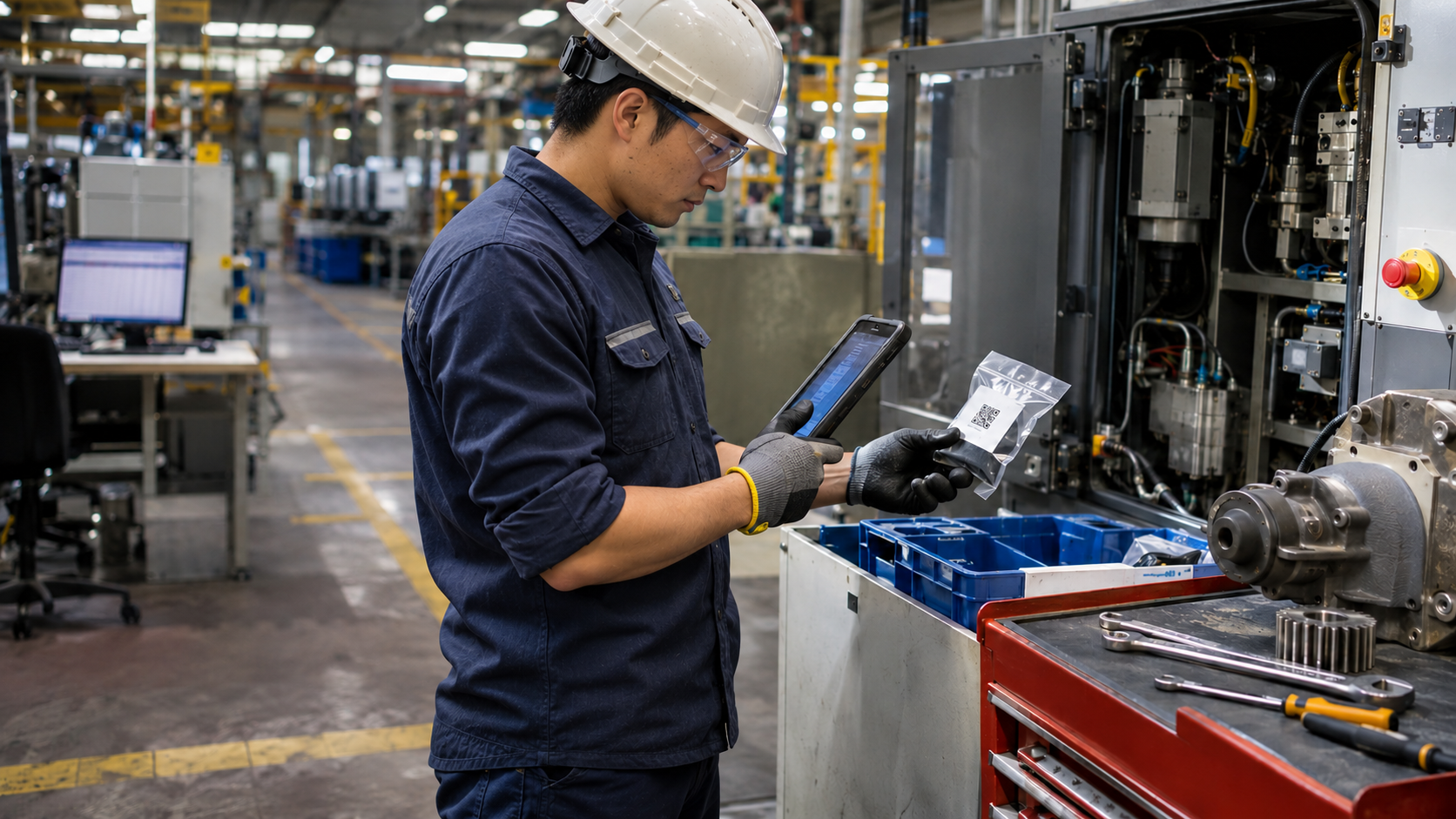
| Part Identification | Manual text searches requiring exact manufacturer or internal SKU numbers. | Instant barcode/QR scanning, visual item photos, and asset-linked BOMs. |
| User Adoption & Training | Steep learning curve; requires specialized training and periodic refreshers. | Consumer-style, B2C mobile interface; technicians learn it in minutes. |
| Offline Functionality | Typically requires a constant hardwired or live network connection. | Stores carts and requisitions offline in dead zones, syncing automatically once reconnected. |
| Financial & Data Sync | Native to finance, but often flooded with messy, unstandardized MRO entries. | Integrates via API to feed clean, consolidated, policy-compliant data back to the ERP. |
How Mobile Procurement Technology Keeps Technicians at the Wrench
To meaningfully reduce technician downtime, the point of requisition must move to the point of repair. Modern mobile procurement technology acts as a lightweight, agile system of engagement that sits right on top of your existing ERP.
When maintenance teams are equipped with dedicated mobile field technician and procurement apps, the entire repair workflow changes:
- Scan-to-Order Speed: Technicians scan a bin label, equipment tag, or barcode with their phone camera to verify real-time storeroom stock or trigger an immediate order—eliminating manual typing errors.
- Visual Catalog Verification: High-resolution images and standardized specs let technicians confirm they are ordering the exact bearing, belt, or valve needed before hitting submit.
- Automated Approval Guardrails: Pre-set spending thresholds and automated routing eliminate email chains. Routine parts order instantly, while high-dollar items route to a supervisor’s phone for one-tap approval.
- Built-In Spend Control: By making the compliant path the easiest path, mobile tools prevent rogue local runs and help organizations reduce maverick spending across indirect categories.
If you are evaluating platforms, make sure your shortlist covers the 6 must-have features in an eProcurement platform so your team gets true field usability rather than a watered-down desktop screen.
Honest Implementation Pitfalls—And How to Avoid Them
In the spirit of radical transparency, adding new software to a plant floor is not magic. If rushed, mobile rollouts can stumble over two common hurdles:
- Digitizing Messy SKU Data: Putting a sleek mobile app on top of a disorganized parts catalog only helps technicians find bad data faster. Cleansing, deduplicating, and enriching item descriptions before launch is non-negotiable.
- Siloed IT Integrations: A mobile tool that does not talk to your ERP or CMMS creates double data entry for buyers and accounts payable. Modern integrations rely on pre-built APIs and cXML PunchOut protocols so orders, receipts, and invoices flow automatically into SAP, Oracle, or Maximo.
Your 3-Step Plan to Reduce Technician Downtime
At SDI, we understand how frustrating it is to watch skilled maintenance teams lose hours every week to administrative friction while critical equipment waits for parts. As your digital supply chain guide, we combine over $1B in managed MRO spend with our proprietary ZEUS eProcurement software to bridge the gap between your finance team’s ERP and your technicians’ daily reality.
Organizations that deploy mobile procurement tools to save money and extend equipment uptime typically see a 15% to 30% reduction in total MRO costs alongside dramatic gains in wrench time. Getting started follows a straightforward three-step process:
- Map Your Floor Workflows and Data: We audit your current requisition paths, storeroom bottlenecks, and SKU catalog to pinpoint exactly where technician hours and dollars are leaking.
- Deploy Mobile Procurement via Seamless API: We cleanse your critical MRO data and connect SDI’s mobile-first ZEUS platform directly to your existing ERP—with zero disruption to your core financial system.
- Reclaim Wrench Time and Uptime: Your technicians order parts from the asset in seconds, your storeroom stays accurately stocked, and your maintenance team shifts from reactive firefighting to proactive reliability.
FAQs
Does mobile procurement technology replace our existing ERP?
No. A specialized eProcurement platform complements your ERP rather than replacing it. Mobile MRO tools handle the high-volume, fast-moving transactions on the shop floor and push clean, consolidated financial and inventory data back into SAP, Oracle, or your system of record.
Why shouldn’t we just use our ERP vendor’s native mobile app?
Most legacy ERP mobile apps are simply shrunken versions of their desktop screens. They still require complex navigation, lack intuitive visual search for MRO parts, and struggle with offline syncing. Purpose-built mobile MRO solutions are engineered specifically around technician workflows—prioritizing barcode scanning, asset BOM lookup, and B2C-level simplicity.
What does integration cost, and how fast is the ROI?
While exact costs depend on facility count, SKU volume, and ERP integration complexity, the cost of inaction is almost always higher. Most enterprises recoup implementation costs within 90 to 180 days through reclaimed technician labor, eliminated emergency freight, and 15% to 30% savings on MRO parts and processing overhead.
What happens if our facility has Wi-Fi dead zones?
Heavy manufacturing plants, basements, and remote utility corridors frequently lack reliable wireless coverage. Enterprise-grade mobile procurement technology includes offline caching—allowing technicians to scan items, build carts, and queue requisitions offline, then automatically transmitting the order the moment their device reconnects to Wi-Fi or cellular data.
Stop Paying Master Technicians to Be Data Entry Clerks
You have a clear choice when it comes to your maintenance operations. You can stick with the status quo—forcing your best technicians to walk back and forth to desktop terminals, lose up to a third of their shift to administrative friction, and leave critical machines waiting on parts. Or, you can put mobile procurement directly in their hands so they can fix problems faster and keep production moving.
Ready to see how much wrench time and MRO spend your facilities can reclaim? Schedule your MRO supply chain assessment with SDI today and turn mobile procurement into your fastest lever for operational resilience.